Why repeated pages, weak canonicals and overlapping intent can reduce your SEO and AI search visibility
Does Duplicate Content Hurt SEO is a question many small business owners only ask after something strange happens in Google Search Console. A page drops. The wrong URL appears in search. A blog post starts competing with a service page. An old campaign page keeps showing instead of the page you actually want people to visit. Duplicate content does not usually mean Google has punished your website, but it can still weaken your visibility. That is why a proper small business SEO review should look at more than keywords. It should check whether each important page has one clear purpose.
This is the Phoenix take: more content is not always better.
A small business website does not need five similar pages trying to say the same thing. It needs one strong page for each clear service, topic or location. Then it needs helpful supporting content around that page.
That sounds simple. In practice, duplicate content can appear very easily, especially on WordPress websites.
What is duplicate content?
Duplicate content means the same, or very similar, content appears in more than one place online. Sometimes this happens across different websites. More often, it happens on the same website without anyone realising.
Near-duplicate content creates a similar problem. The words may not match exactly, but the page still answers the same question for the same person.
For example, a counselling website might have separate pages called:
- Anxiety counselling
- Therapy for anxiety
- Help with anxiety
- Anxiety support
Those pages could all have a valid role. However, if each page says almost the same thing, the website becomes harder to understand rather than more helpful.
The key question is not, “Have I used the same words?” The better question is, “Does this page have a different job?”
One page might work as a service page for people ready to book. Another could explain what happens in a first session. A third might answer a common question. Those pages can support each other because each one meets a different need.
Problems start when several pages try to rank for the same query.
Why duplicate content can weaken rankings
Search engines use signals to decide which page to show. These signals include page copy, headings, internal links, backlinks, user behaviour, freshness and technical tags.
When all of those signals point to one clear page, Google receives a stronger message.
If the same topic spreads across several similar pages, that message becomes weaker.
Instead of one strong page collecting the value, your website may end up with several weaker pages. Clicks split across different URLs. Links point to different versions. Internal links may send mixed signals. Google may choose a page you did not want to rank.
This is why duplicate content can feel so frustrating. You may have useful content, but your site structure stops it working as well as it could.
Search Console can also become harder to read. Impressions may spread across several URLs. One page might rank for a query one month, then another page might appear the next month. That makes it harder to know which page is actually performing.
For a small business, that matters. Most small websites do not have huge authority to waste. Every service page, article and location page needs to earn its place.
Duplicate content is not always a Google penalty
This is the part that often causes confusion.
Duplicate content does not usually mean Google has punished your site. In many cases, Google simply chooses one version and filters out the others. That may sound fine, but it only works in your favour if Google chooses the version you wanted.
If your preferred page is not obvious, another version may appear instead. It might be an older page, a thin archive, a URL with tracking parameters, or a page that does not convert as well.
Canonical tags, redirects and internal links all help search engines understand which page should carry the main signal.
Think of duplicate content less as breaking a rule and more as giving mixed directions. If your website points Google in three different directions, Google has to make its own decision.
The WordPress issues I would check first
WordPress gives small businesses a flexible way to manage content. That flexibility can also create duplication if the structure grows without regular checks.
Common WordPress issues include:
- Category pages appearing in search when they add little value
- Tag archives creating lots of thin pages
- Author archives repeating blog listings
- Media attachment pages showing as separate URLs
- Staging sites being visible to search engines
- HTTP and HTTPS versions both loading
- URLs with and without trailing slashes
- Old pages staying live after a redesign
- Similar service pages with only minor wording changes
A website redesign can also create duplicate content. The new site may look better, but the structure underneath might be less clear than before.
For example, an old website may have had one strong service page. A new build might add extra landing pages, archive pages, category pages and template sections. If Google can index all of them, it has more to sort through.
The fix is not to panic. The fix is to tidy the signals.
Why this matters for AI search
AI search does not remove the need for SEO. It makes clarity even more important.
Generative Engine Optimisation, or GEO, focuses on helping AI search systems understand who you are, what you do and whether your content can help answer a user’s question. However, AI tools still need clear information. They need strong context, useful sources and pages that answer a specific need.
If your website repeats the same message across several URLs, AI systems may struggle to choose the best source. They may group similar pages together. They may pick an older version. Thin or repetitive pages may also carry less value because they do not add much that feels distinct.
This matters because AI search often summarises, compares and recommends. A clear, specific page gives it more to work with than five vague pages saying almost the same thing.
A mortgage adviser, for example, might have one main page for remortgaging. That page should feel clear, detailed and trustworthy. Supporting articles could then answer questions about fixed-rate deals, product transfers, affordability or complex income.
That structure works better than several short pages all saying, “We can help with remortgaging.”
SEO gives the structure. GEO builds on that structure.
Where canonical tags fit in
A canonical tag tells search engines which URL should count as the main version of a page.
This helps when similar pages need to stay live, but one version should collect the SEO value. Google’s own guidance on canonical URLs explains how site owners can use canonical signals to guide search engines towards a preferred URL.
Canonicals can help, but they do not replace good structure.
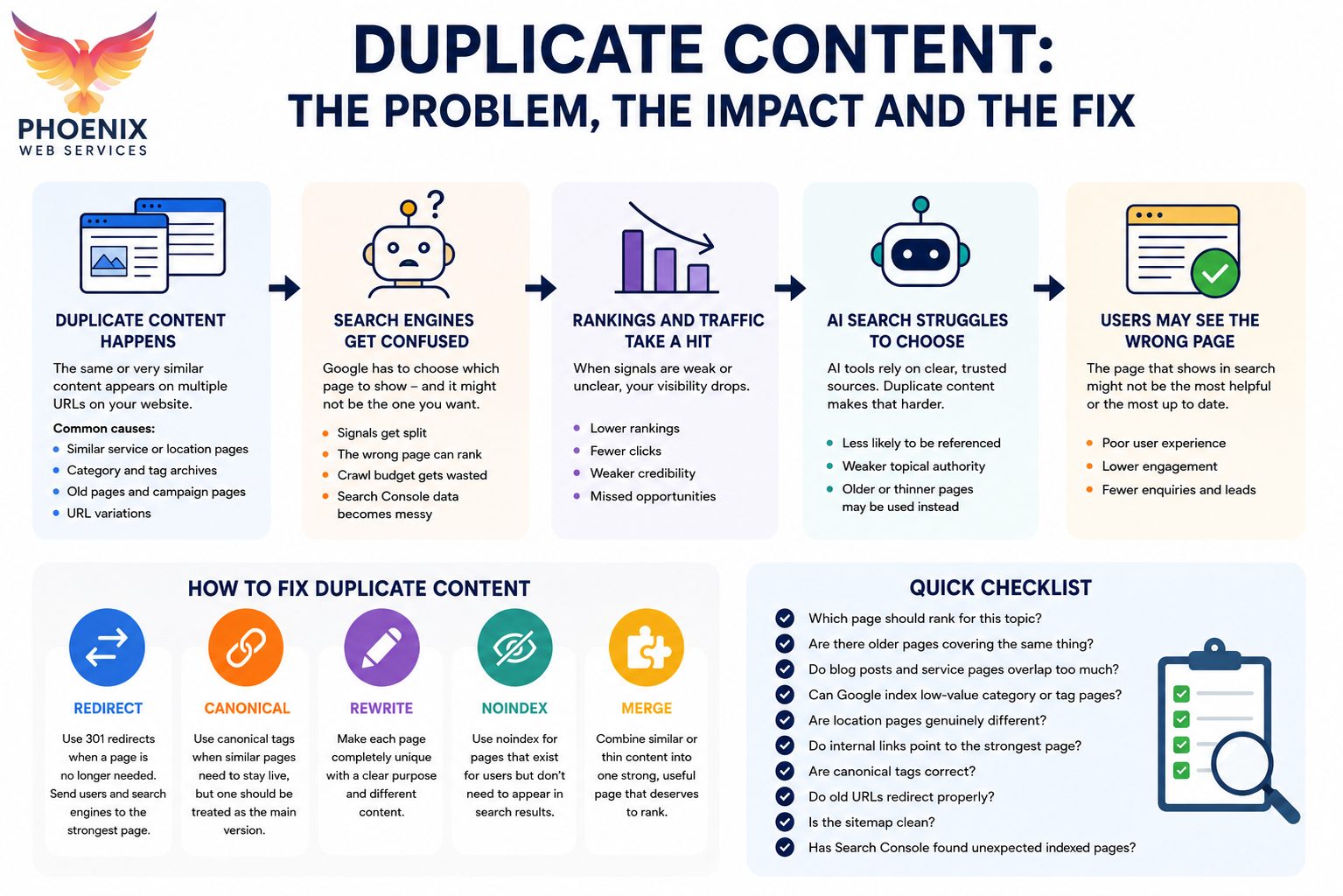
If you no longer need two pages, merge them and redirect the weaker one. If two pages serve different users, rewrite them so the difference feels obvious. When a page has no search value, a noindex tag may work better.
The point is to choose the right tool for the job.
Redirect, canonical or rewrite?
This is where many small business owners get stuck.
Use a 301 redirect when a page no longer needs to exist. This sends users and search engines to the stronger page. It works well for old blog posts, moved service pages, expired offers and pages removed during a redesign.
Use a canonical tag when similar pages need to remain live, but one page should act as the main version. This can help with some campaign pages, filtered URLs or technical variants.
Choose a rewrite when two pages have a reason to exist, but they currently sound too similar. This often happens with service pages and location pages.
Use noindex when a page needs to stay available for users, but does not need to appear in search results. Some thin archive pages may fall into this category.
Merge content when several weak articles could become one stronger guide.
There is no single answer for every page. The right fix depends on the purpose of the content.
Location pages need real local value
Location pages often create duplicate content problems.
It can feel efficient to create one page, copy it several times, and change the town name. That might look like local SEO, but it rarely creates the strongest result.
A useful location page should offer something genuinely relevant to that area. It might include nearby places served, local examples, travel details, location-specific FAQs, testimonials, photos, or clear context around how the service works in that area.
For Phoenix Web Services, this matters because many small UK businesses want local visibility. Local SEO works best when the page feels genuinely local, not copied.
The aim is not just to mention a place name. The aim is to show why that location page deserves to exist.
Campaign pages can create confusion
Campaign pages can work very well, but they can also create unnecessary duplication.
A business might create one landing page for Google Ads, another for an email campaign, another for a seasonal offer, and another for social media. If those pages are almost identical, they add noise.
That does not mean campaign pages are a bad idea. They just need a clear purpose.
If a campaign page does not need to rank, keep it out of the search index. When a campaign page should rank, make sure it offers something unique. For short-term pages, plan what happens after the offer ends.
Old campaign pages are easy to forget. Search engines may keep finding them.
Where IndexNow can help
IndexNow can help search engines find changes faster when pages change, move or disappear.
This can support a duplicate content clean-up. For example, you may redirect old URLs, update canonical tags, remove thin pages, or publish a stronger consolidated guide. IndexNow can help participating search engines discover those changes sooner.
However, IndexNow does not fix duplicate content on its own.
Avoid using it as a way to submit every URL again and again. The main work still comes first: choose the preferred page, tidy the structure, update internal links and remove unnecessary overlap.
Once you have done that, IndexNow can support faster discovery.
The Phoenix rule: one page, one purpose
My rule for Phoenix content is simple: one page, one clear purpose.
That does not mean your website should be tiny. It means every page should earn its place.
A service page should help someone understand what you offer and take the next step. A blog article should answer a useful question. A location page should support local relevance. A case study should show evidence. A category page should help users browse related content.
If a page does not have a clear purpose, review it.
You might improve it. You might merge it. You might redirect it. You might keep it live, but remove it from search.
The goal is not fewer pages for the sake of it. The goal is stronger pages with clearer signals.
A simple duplicate content checklist
Start with your most important services and ask:
- Which page should rank for this topic?
- Are there older pages covering the same thing?
- Do blog posts and service pages overlap too much?
- Can Google index low-value category or tag pages?
- Are location pages genuinely different?
- Do internal links point to the strongest page?
- Are canonical tags correct?
- Do old URLs redirect properly?
- Is the sitemap clean?
- Has Search Console found unexpected indexed pages?
You do not need to fix the whole website in one go. Start with the pages that matter most for leads and enquiries.
This also links to AI visibility. In our article on how ChatGPT recommends businesses, we looked at how clear online signals help AI systems understand and recommend a business. Duplicate content does the opposite. It adds noise.
Final thoughts
So, does duplicate content hurt SEO?
Yes, it can. Not always because of a penalty, but because it makes your website harder to understand.
It can split ranking signals. It can leave the wrong page showing in search. Search Console data can become messy. Discovery can slow down. AI search visibility can also become weaker when your pages send mixed messages.
The fix is not to keep publishing more and hoping for the best. A cleaner structure gives each page a better chance to work.
One topic. One strongest page. Clear supporting content. Sensible internal links. Correct redirects. Useful canonicals. Fewer mixed signals.
That is the Phoenix approach to duplicate content: less clutter, stronger pages and clearer visibility across both search and AI search.