What small businesses need to know about being found in AI search
How ChatGPT Recommends Businesses is a question more small business owners are starting to ask. A few years ago, most of us were thinking mainly about Google. Now, people are also wondering whether tools like ChatGPT, Google AI Search, Gemini and Perplexity might mention their business when someone asks for help, advice or a recommendation.
It is a fair question. ChatGPT business recommendations are already shaping how some people look for information. However, it is also an area where there is a lot of overclaiming.
The honest answer is this: nobody outside OpenAI can tell you exactly how ChatGPT chooses which businesses to mention. Anyone promising a guaranteed way to get your business recommended by ChatGPT is probably saying more than they can prove.
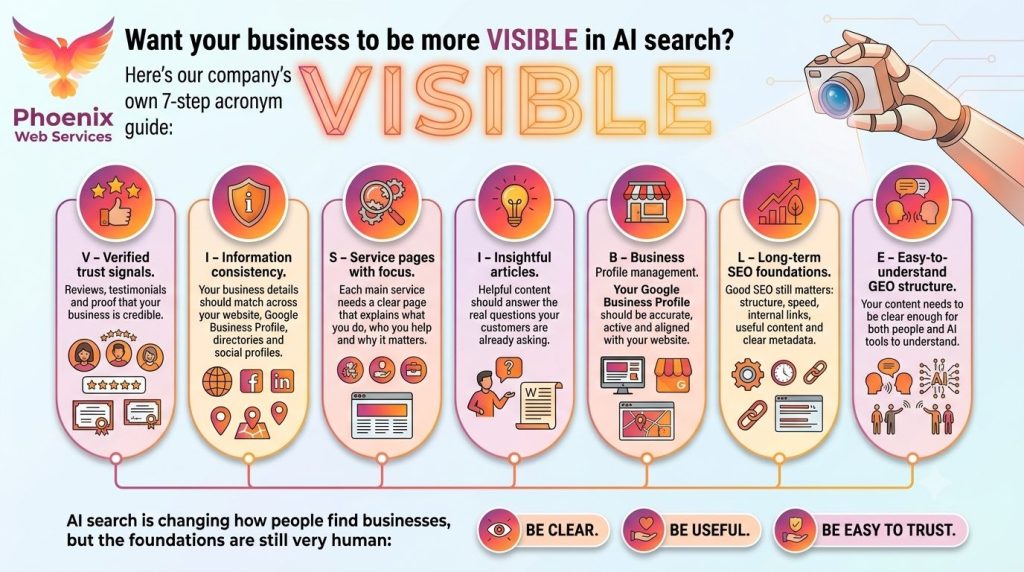
That does not mean there is nothing you can do. In fact, many of the things that help with AI visibility are the same things that already support good SEO: clear website content, useful service pages, trust signals, reviews, consistent business information and helpful articles that answer real questions.
If you are already working on SEO services for small businesses, this is not a completely separate job. It is really the next stage of being visible online. You may also find it useful to read our guide to Understanding SEO vs GEO in 2026 and our article on how Google AI Search Is Changing.
AI search does not replace the need for a good website. If anything, it makes a clear, trustworthy website even more important.
ChatGPT is not choosing favourites
It helps to start with what ChatGPT is not doing.
It is not sitting there deciding which business it personally likes best. It is not rewarding the company that has stuffed the most keywords into a page. Nor is it working from one simple public checklist that any SEO agency can reverse engineer.
When someone asks a question such as “Who offers SEO for small businesses in the UK?” or “Which web designer is good for therapists?”, the tool needs to give a useful answer. To do that, it needs information it can understand and connect.
That is where your wider online presence matters.
Depending on the tool, the query and whether live search is being used, AI systems may refer to websites, search results, business profiles, reviews, directories, articles and other public information. The mix will not always be the same. So, rather than trying to trick ChatGPT, the better aim is to make your business clear, consistent and easy to understand.
That might sound simple, but many small business websites do not do this very well.
Clear positioning matters
If your website does not clearly explain what you do, who you help and where you work, both people and AI tools have to work harder.
A lot of business websites use phrases like:
“We provide bespoke digital solutions for ambitious brands.”
It sounds professional, but it does not say very much. A clearer version would be:
“We provide WordPress web design, SEO and website support for small UK businesses, therapists, wellbeing providers and local service businesses.”
The second version is much easier to understand. It explains the service, the platform, the audience and the location. As a result, it gives search engines and AI tools more useful context.
This is where plain English often works better than clever marketing language. Your website does not need to sound complicated to be credible. It needs to be specific.
If you offer web design, say web design. If you support therapists, say that. If you work with small UK businesses, make that clear. Otherwise, your website may look polished but still fail to explain why your business is relevant.
How ChatGPT Recommends Businesses in practice
How ChatGPT Recommends Businesses will depend on the question being asked.
A broad question may lead to a general answer. A local question may rely more heavily on location signals. A specialist question may need clearer signs of experience and trust.
For example, if someone asks:
“Who can build a website for a counsellor in the UK?”
An AI tool may need to understand several things. Does the business offer website design? Does it understand counsellors, therapists or wellbeing providers? Is the business based in the UK, or does it serve UK clients? Are there relevant service pages, examples, testimonials or useful articles?
A thin website with one generic service page may struggle here. It might mention web design, but it may not give enough evidence to show that the business understands therapy websites.
By contrast, a clearer website gives more to work with. A dedicated therapy website design page, helpful blog posts, client examples, reviews and a strong About page all help build a fuller picture.
That does not guarantee a recommendation. However, it does make your business easier to understand when the topic is relevant.
Authority comes from useful content
AI discoverability is closely linked to topical expertise.
If your website has one short page about SEO, it may be difficult to show depth. However, if your website has a useful group of articles around small business SEO, local SEO, Google Business Profile, AI search, GEO, website copy and technical SEO, the overall picture becomes much stronger.
This does not mean posting random blogs just to keep the website active. It means answering the questions your ideal clients are already asking.
For Phoenix Web Services, future supporting articles could include:
- What makes a website AI-readable?
- Does schema help AI search?
- How AI search is changing local SEO
- Entity SEO explained for small businesses
- How to get your business recommended by AI search
Each article should have a clear job. Ideally, it should answer one main question properly and then guide the reader to the next useful page.
This helps real people move through your website. It also helps search engines and AI tools understand how your topics connect.
Trust signals matter more than ever
When people ask for business recommendations, trust matters. That is true whether the recommendation comes from a friend, Google, ChatGPT or another AI tool.
For small service businesses, useful trust signals include:
- Clear contact details
- A real About page
- Reviews and testimonials
- Case studies or portfolio examples
- Clear service descriptions
- Pricing guidance where appropriate
- Author information on blog posts
- Privacy and cookie pages
- Consistent business details across the web
These signals are especially important for therapists, wellbeing providers, legal services, finance-related businesses and anyone working in a field where people need to feel safe before making contact.
This is where E-E-A-T comes in: experience, expertise, authoritativeness and trustworthiness. It is not a score you can look up. Instead, it is a useful way to think about whether your website gives people enough reason to trust you.
If your website feels vague, anonymous or out of date, that can weaken trust. On the other hand, if it feels clear, current and genuinely helpful, it gives both people and search systems more confidence.
Brand mentions help create context
A brand mention is when your business is named somewhere online, even if there is no link. This might happen in a local article, directory, guest post, supplier page, podcast note, review platform, social profile or partner website.
Traditional SEO has often focused heavily on links. Links are still important, but AI visibility may also be influenced by broader brand context.
For example, if your business is consistently mentioned alongside WordPress web design, SEO, small business support, therapist websites and UK services, that helps build a clearer picture of what your business is about.
This does not mean signing up to every directory you can find. Spammy listings are not the answer. Instead, it means being visible in sensible places that are relevant to your work.
Good places to start include your Google Business Profile, local business directories, relevant professional directories, partner websites and social media profiles with clear descriptions.
Consistency is the key. Your business name, website, location, services and description should broadly match wherever you appear.
Your Google Business Profile helps
For local and service-based businesses, your Google Business Profile is still one of the clearest sources of business information online.
It tells Google what your business does, where you operate, how people can contact you, what services you offer and what customers say about you.
A strong profile should include the correct business category, a clear description, up-to-date services, accurate contact details, useful posts, good-quality images and genuine reviews. It is also worth replying to reviews in a human way, rather than using the same bland response every time.
Your Google Business Profile should not feel disconnected from your website. Ideally, your profile, service pages and website copy should all tell the same story.
For example, if your website says you support small businesses across the UK, your profile should not make it sound as though you only work in one small local area. Likewise, if your profile lists SEO and web design, your website should have strong pages for both.
Helpful content is still the foundation
In the middle of all the noise around AI, it is easy to forget the basics.
OpenAI’s own explanation of ChatGPT Search talks about timely answers with links to relevant web sources. That means your website content still matters.
People are still asking practical questions. They want to know how much SEO costs, whether WordPress is better than Wix, how long SEO takes, what should go on a homepage, why their traffic has dropped and whether AI search changes what they need to do.
Good content answers those questions clearly.
A strong SEO copywriting agency approach is not about adding keywords wherever they fit. It is about shaping a page so it is genuinely useful. That means clear headings, natural wording, sensible internal links and a next step that makes sense.
That is good for SEO. It is also good for GEO.
Structure helps AI understand
Structured content simply means your website is organised properly.
Each important page should have one clear topic. Headings should describe what each section is about. Paragraphs should be short enough to read comfortably. Internal links should connect related pages. FAQs can help answer common questions. Schema may also help search engines understand parts of the page more clearly, where it is used correctly.
A confused website structure can make things harder.
For example, if five different pages all try to rank for “small business SEO services”, Google may not know which page matters most. AI tools may also struggle to understand which page gives the best answer.
For most small business websites, the aim should be simple: give each core service a clear home.
If you offer web design, SEO, copywriting and Google Business Profile support, each service needs its own focused page. Blog posts can then support those pages by answering related questions.
Over time, that creates a stronger, more connected website.
What should small businesses do now?
You do not need to panic about AI search. You also do not need to rebuild your website every time a new tool appears.
However, it is worth checking whether your current website is clear enough for the way search is changing.
Start with these practical steps:
- Check whether your homepage says what you do, who you help and where you work.
- Make sure each core service has its own focused page.
- Remove vague wording that sounds nice but says very little.
- Add useful articles that answer real client questions.
- Strengthen your About page, testimonials and case studies.
- Keep your Google Business Profile accurate and active.
- Make your business details consistent across directories and social profiles.
- Use internal links to connect related services and articles.
- Review your page titles and meta descriptions.
- Make sure your website gives people a clear next step.
None of this is a quick trick. But that is the point. The businesses most likely to benefit from AI search are not necessarily the ones chasing shortcuts. They are the ones building clear, trustworthy and useful online visibility.
Final thoughts
How ChatGPT Recommends Businesses may change as AI search develops. However, the direction is already becoming clear.
AI tools need information they can understand. People need information they can trust. So, the best place to start is with a website that explains your business clearly, answers useful questions and gives visitors confidence.
The aim is not to become visible to AI instead of people. The aim is to make your business easier for both people and AI tools to understand.
If your website has not been reviewed for SEO, GEO or AI search visibility, Phoenix Web Services can help. You can request a Free SEO Audit or Book A Meeting for practical, plain-English advice.
For a wider look at what is changing across search, websites and online visibility, you may also find our article on Digital Marketing Changes 2026 useful.