Digital Marketing Changes 2026 for Small UK Businesses
‘Digital Marketing Changes 2026 Explained’ is not about panic, hype or chasing every new platform update. It is about understanding what has changed and what small UK businesses should do next. The latest digital marketing changes in 2026 affect Google, LinkedIn, AI content, website performance and social media visibility. So, if your website feels unclear, slow or outdated, our SEO services for small businesses can help you work out what needs attention first.
I see this a lot with small business websites. The issue is rarely that the business has nothing useful to say. More often, the useful information is already there in emails, client calls, quotes and everyday conversations. It just has not made its way onto the website yet.
That matters more now because search and social media are changing quickly. However, the basics still matter. Your website needs to explain what you do, who you help and why someone should trust you. In addition, your content needs to answer real questions in a clear and useful way.
The difference in 2026 is that weak content is easier to ignore. Search engines and social platforms are getting better at spotting vague, thin or automated content. As a result, small businesses need to sound more human, and less AI.
Digital Marketing Changes 2026: The Short Version
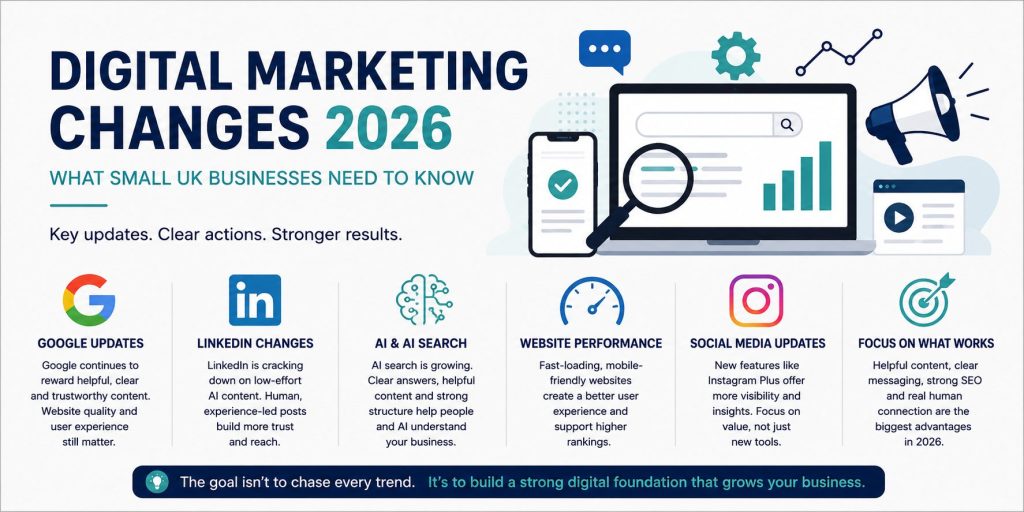
The main message is simple. Helpful, clear, authoritative and trustworthy content is becoming more important.
Google is continuing to refine how it judges useful pages. Meanwhile, LinkedIn is taking action against low-effort AI content. AI tools are also becoming part of everyday marketing, and Instagram is testing new paid features for users who rely on Stories.
For small businesses, this does not mean doing more marketing every day. Instead, it means making better use of what you already have.
A clear service page can work harder than ten vague blog posts. Likewise, a useful LinkedIn post can build more trust than a polished but empty AI update. When your website is fast, easy to use and well written, people feel more confident before they enquire.
In August 2026, Google also added Gemini 3.7 Flash as a selectable paid model in AI Mode, providing another clear example of how AI-assisted Search is continuing to develop.
LinkedIn Is Challenging AI Slop
LinkedIn has said it is taking steps to reduce low-effort AI-generated content and automated activity. That does not mean AI is banned. Rather, it means bland, generic content is becoming a problem.
AI can help with ideas, structure and editing. Even so, your posts still need your voice. They need your experience, your examples and your point of view.
For small business owners, this is actually good news. You do not need to sound like a corporate marketing team. Instead, you need to sound like a real person who understands your clients.
A strong LinkedIn post might answer a common client question. It could explain a mistake to avoid. Alternatively, it might share something you have learned from a recent project. That kind of content is harder to fake.
What LinkedIn Content Needs Now
Your LinkedIn profile and posts should make your expertise clear. If you are a counsellor, designer, consultant, tradesperson or local service provider, stay close to your main topic.
This helps people understand what you do. It may also help platforms understand who your content is useful for.
Rather than trying to cover everything, choose a few core themes. Then talk about them often. Add real examples, keep your tone natural and avoid over-polished language.
A helpful test is to ask, “Would I say this to a client?” If the answer is no, edit it.
Google Updates Still Matter
Google’s May 2026 core update completed on 2 June 2026. Core updates are broad changes to Google’s ranking systems. Usually, they are not about one single ranking factor.
That matters because some advice online can sound more dramatic than it needs to. For example, Google has not said that one failed Core Web Vitals metric now creates a new compounded penalty. Core Web Vitals still focus on loading performance, interactivity and visual stability.
In plain English, Google wants websites to load well, respond quickly and avoid jumping around while people use them. You can read Google’s own guidance here: Google Search Central core update guidance. For the Google ranking, AI Search and reporting developments confirmed during August, see our August 2026 SEO news roundup.
Website Quality Is Still Essential
Although there is no need to panic, website quality still matters. People will not wait around for a slow site. They are also less likely to trust pages that feel confusing.
This is where small improvements can make a big difference.
Compress large images. Remove plugins you do not need. Make your buttons clear. Check your website on mobile. Then review your most important service pages.
These actions help traditional SEO. They also support AI search because they make your content easier to understand.
AI Search Needs Clear Answers
One of the biggest digital marketing changes 2026 is the growth of AI search. People are not only clicking through a list of search results. Increasingly, they are also seeing AI summaries, suggested questions and answer-led search layouts.
This means your website needs to answer questions clearly. A vague page is less useful to a person, and it is less useful to AI systems.
For example, a therapist’s website should not only say, “I offer counselling.” It should help someone understand who the service is for, how sessions work, what the next step feels like and whether the tone of the practice feels right for them.
The same applies to any service business. A mortgage adviser, designer, consultant or tradesperson should explain what is included, who they help and what happens after someone gets in touch.
By doing this, you give search engines more context. More importantly, you help potential clients feel safer and more informed. Learn more about how ChatGPT may recommend businesses in this article.
This is what AI readability means in practice. My guide to making a website easier for AI systems to understand explains the main features to review.
AI Marketing Automation Is Growing
AI marketing automation is becoming more common. Gartner has reported that marketing leaders expect AI-driven automation of marketing work to rise from 16% in 2026 to 36% by 2028.
That is a major shift. However, it does not mean small businesses should hand over their marketing to AI.
The best use of AI is support. It can help with research, blog planning, email outlines, content ideas and reports. At the same time, it can make mistakes.
Human judgement still matters. You need to check the facts, protect your tone and make sure your content reflects your business. My view is that AI can be a brilliant assistant, but it should not be the person in charge of your brand voice.
Instagram Plus Is Worth Watching
Meta has started rolling out paid “Plus” subscriptions for platforms including Instagram. Reported Instagram Plus features include longer Story visibility, more audience controls and extra Story insights.
For some businesses, this may be useful. It could help if you already use Stories well and have an active audience.
Even so, it is not a magic fix. If your Instagram profile is unclear, paid features will not solve that. If your Stories are inconsistent, more visibility may not help.
Start with the basics. Make your bio clear, show what you offer and use simple calls to action. After that, test extra features only if they support your wider strategy.
Digital Marketing Changes 2026: What to Do Next
The best response to these updates is calm action. Rather than chasing every trend, strengthen your foundations first.
Start with your website. Check whether your main pages clearly explain your services. Each page should have one clear purpose. It should also guide visitors towards the next step.
Next, look at your content. Are you answering real client questions? Are you showing your expertise? Does your writing sound human?
Finally, review your trust signals. Add testimonials where appropriate. Keep your Google Business Profile updated. Make your contact details easy to find. In addition, link related pages together so visitors and search engines can follow the journey.
These steps support SEO, GEO and AI search visibility.
SEO and GEO Now Work Together
SEO helps people find your website through search engines. GEO, or generative engine optimisation, helps your content become clearer and more useful for AI-led search experiences.
The two are closely connected. You do not need a separate website for AI search. Instead, you need better content, clearer structure and stronger trust signals.
Digital marketing changes 2026 are not about replacing everything you already know. They are about raising the standard.
Helpful content still matters. Fast websites still matter. Clear headings still matter. Local trust still matters. Above all, human experience still matters.
My honest advice is this: do not panic about AI search, but do not hide behind vague website copy either. The clearer and more useful your content is, the easier it becomes for both people and search engines to understand why your business is the right fit.
Need help reviewing your website?
If your website feels thin, confusing or out of date, now is a sensible time to review it. Phoenix Web Services helps small UK businesses improve their websites, SEO and content in a calm, practical way. For friendly, straightforward support, you can contact Phoenix Web Services and ask for a practical website or SEO review.
Are you a therapist or Counsellor? You may also find this article of assistance: Should counsellors use AI to generate website copy?