Choosing a Small Business Web Designer Who Understands Your Business
Choosing the right small business web designer is not always straightforward. You may be starting from scratch, replacing an old DIY website, or trying to recover from a previous project that did not quite deliver what you needed.
It is easy to compare web designers by price alone. However, a small business website has an important job to do. It needs to explain what you offer, build trust, guide people towards an enquiry, and support your visibility in Google. It also needs to be manageable after launch, not something that becomes another source of stress.
That is why the best choice is not always the cheapest quote, or even the designer with the most dramatic portfolio. For most small businesses, the right web designer is someone who understands how smaller organisations actually work.
If you are planning a new website, our Small Business Website Design service explains how Phoenix Web Services builds practical WordPress websites for small UK businesses, therapists and values-led organisations.
Why Small Businesses Need a Different Kind of Website Support
A small business website is often your shop window, brochure, enquiry tool and trust builder all in one place.
Unlike larger companies, most small business owners do not have a marketing department, in-house copywriter, SEO specialist and technical support team sitting behind them. You may be doing everything yourself between client work, admin, accounts and family life.
A good small business web designer should understand that.
They should be able to guide you through the process clearly, explain what matters and help you make sensible decisions. Also, they should not overwhelm you with jargon or expect you to know the difference between hosting, domains, plugins, redirects and schema before the project has even started.
Good design matters, of course. However, your website also needs structure, clear wording, search visibility and a simple route for people to contact you.
Start With What Your Website Needs To Do
Before choosing a web designer, it helps to be clear about what you need the website to achieve.
Do you want more enquiries?
Do you need to look more established?
Are you trying to explain several services clearly?
Do you want to appear in local search results?
Are you moving away from a DIY platform because the site no longer fits?
These questions matter because they affect the whole project. A website built purely to “look nice” may not support your business in the way you hoped.
For example, a therapist, local tradesperson, consultant, online shop and community organisation all need different website structures. The design should follow the purpose of the site, not the other way round.
If you are still weighing up options, the Website Design Packages page gives a useful overview of different ways to approach a small business website without needing a large upfront budget.
Questions Your Web Designer Should Ask You
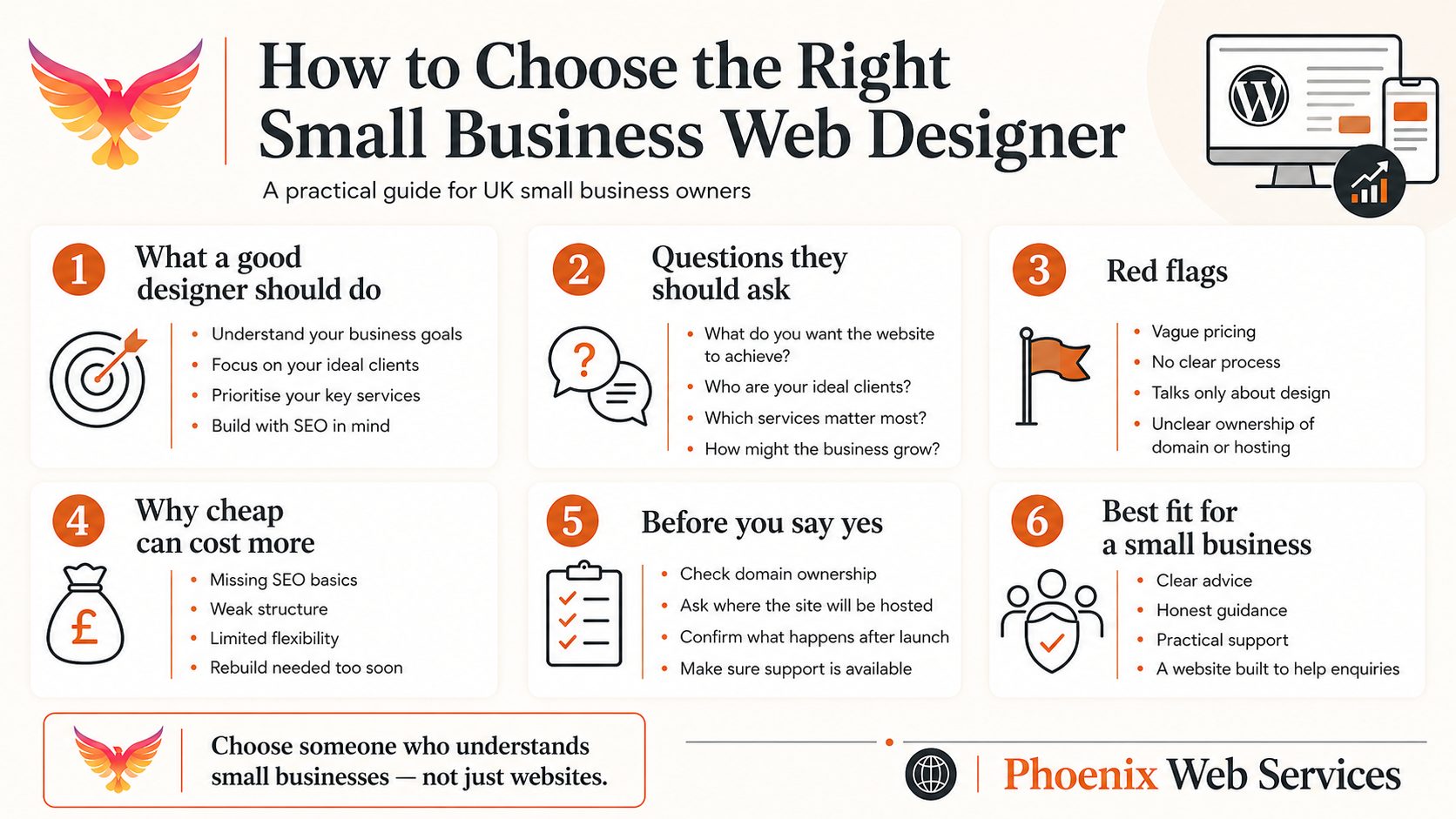
A good small business web designer should ask thoughtful questions before they start building. If they only ask what colours you like, or how many pages you want, they may miss the bigger picture.
What are your business goals?
Your website should support your wider business goals.
That may mean increasing enquiries, attracting a different type of client, explaining a new service, reducing unsuitable leads, or improving your professional credibility.
When a designer understands the goal, they can make better choices about layout, copy, calls to action and navigation.
Who are your ideal clients?
Your website should speak clearly to the people you most want to reach.
This does not mean excluding everyone else. It simply means making sure the right visitors feel reassured, understood and able to take the next step.
A website for a counselling practice will usually need a different tone from a website for an engineering company or a farm shop. The words, images and layout should fit the people who are most likely to use the service.
Which services are most profitable or important?
Not every service needs equal space on your website.
A good designer should ask which services matter most commercially, which ones you want to grow, and which ones are useful but less central. This helps shape the homepage, service pages, internal links and calls to action.
It also helps avoid a common small business website problem: everything being given the same level of importance, which can make the site feel flat and confusing.
Who are your competitors?
Competitor research is not about copying other businesses.
It helps your designer understand what visitors may already be seeing, what expectations exist in your sector, and where your website can be clearer, warmer or more useful.
Sometimes the opportunity is not to be louder. It is to be easier to understand.
What SEO foundations are needed?
A website does not need to become an SEO project overnight, but basic SEO should be built in from the start.
Google’s own SEO Starter Guide explains that SEO helps search engines crawl, index and understand your content. In practical terms, this means your designer should think about headings, page titles, URLs, internal links, image alt text, mobile performance and content structure.
These are not optional extras if you want your website to be found.
How might the business grow?
Your website should fit where your business is now, but it should not block where you might go next.
You may want to add a blog, booking system, location pages, resources, case studies, new services or team members later. A good web designer will build with that future in mind, so the site can grow without needing to be rebuilt too soon.
Common Red Flags When Comparing Web Designers
Most web designers want to do a good job. However, there are still some warning signs to watch for.
Be cautious if a designer cannot clearly explain what is included in the price. A “five-page website” can mean very different things depending on whether copy guidance, SEO basics, contact forms, mobile checks, training, hosting and support are included.
It is also worth pausing if the designer talks only about appearance. A website can look polished and still perform poorly if the structure is weak, the content is thin, or the calls to action are unclear.
Another red flag is unclear ownership. You should know who owns the domain, where the website is hosted, and what happens if you want to move away in the future.
You should also feel comfortable asking questions. If someone makes you feel silly for not knowing the technical side, they may not be the right fit for your small business.
Why Cheap Websites Often Become Expensive
There is nothing wrong with working to a budget. Most small businesses need to be careful with costs, especially in the early stages.
The problem is when a cheap website leaves out important foundations.
A low-cost build can become expensive if it does not include mobile checks, basic SEO, clear navigation, security, backups, redirects from an old website, or the ability to update content easily.
It can also become expensive if you outgrow it quickly and have to start again.
This is why value matters more than the lowest number on a quote. A good website should give your business a stronger foundation, not just a set of pages.
If you are trying to decide whether to stay with a DIY builder or move to WordPress, our guide to Wix vs WordPress for small businesses may help you compare the options more clearly.
Ownership of Domains, Hosting and Website Access
Your domain name is a business asset. You should own it and have access to the account where it is registered.
Hosting is slightly different. Some businesses manage their own hosting, while others prefer their web designer to handle it for them. Either option can work, as long as everything is clear.
Before agreeing to a project, ask:
Who owns the domain?
Where will the website be hosted?
Will I have admin access?
Are backups included?
What happens if I leave?
Is email included or separate?
Phoenix offers Web Hosting for small businesses that prefer a managed option, but the key point is transparency. You should not feel trapped because the technical setup has been hidden from you.
SEO Should Be Considered Before the Website Goes Live
SEO is much easier to build in properly than to fix afterwards.
This does not mean every small business needs an expensive SEO campaign from day one. However, your website should still have clear page titles, sensible headings, descriptive URLs, internal links and content that reflects what your customers are actually searching for.
If you are replacing an existing website, SEO becomes even more important. Changing URLs, deleting pages or rewriting content without a plan can affect rankings and traffic.
Before a redesign goes live, it is worth working through a proper Website Redesign Checklist, especially if your current site already receives visits from Google.
You should also avoid creating several pages that all target the same search intent. If you already have repeated or overlapping content, our article Does Duplicate Content Hurt SEO? explains why clarity matters.
Ongoing Support After Launch
A website is not finished forever once it goes live.
WordPress updates, plugin checks, backups, security monitoring and small content changes all matter. Some business owners are happy to manage these tasks themselves. Others would rather know someone is keeping an eye on things.
Neither option is wrong. The important thing is knowing what happens after launch.
Ask your web designer whether they offer support, what is included, how quickly they usually respond, and whether small changes are covered or charged separately.
If you want help keeping your website updated and secure, Phoenix offers Website Maintenance Plans for small businesses that prefer ongoing support.
Choose Someone Who Understands Small Businesses, Not Just Websites
The right small business web designer should understand more than layout and plugins.
They should understand that your website is part of your business. It needs to fit your budget, your confidence level, your available time and your future plans.
Additionally, they should be able to advise without pushing, explain without overwhelming. And they should help you make decisions that are right for your business, rather than selling features you do not need.
At Phoenix Web Services, this is central to how we work. We are a small, woman-led web design and SEO business, supporting small businesses, therapists, charities and values-led organisations with clear, practical websites. You can read more about our approach on the About Phoenix Web Services page.
Final Thoughts
Choosing the right small business web designer is not just about finding someone who can build a website.
It is about finding someone who can understand your business, ask the right questions, and create a website that supports where you are now while leaving room for where you want to go next.
A good website should feel clear, trustworthy and easy to use. It should help people understand what you do, why it matters and how to take the next step.
If you are planning a new website and would like a calm, no-pressure conversation, you are welcome to Book A Meeting with Phoenix Web Services.
Frequently Asked Questions
What should I look for in a small business web designer?
Look for a web designer who asks about your goals, ideal clients, services, SEO needs and future plans. A good designer should explain the process clearly and help you understand what is included.
How much does a small business website cost?
The cost depends on the size of the website, the level of design, content support, SEO foundations and ongoing help included. Rather than choosing the cheapest quote, compare what each package actually includes.
Do I need SEO when building a new website?
Yes, at least at a basic level. Your website should have clear headings, page titles, meta descriptions, internal links, mobile-friendly design and content that search engines can understand.
Should I use WordPress for a small business website?
WordPress is a strong option for many small businesses because it is flexible, scalable and widely supported. However, the right platform depends on your goals, budget and how much control you want long term.
Should I own my domain name?
Yes. Your domain is an important business asset, so it should be registered in your name or business name. A web designer can help manage the technical setup, but ownership should remain clear.
What happens after my website goes live?
After launch, your website will still need updates, backups, security checks and occasional content changes. Ask your designer what support is available so you know what happens once the project is complete.