How AI agents could search, compare and act for customers
AI agents are coming, and small business websites need to be ready for more than a traditional Google search. Good SEO services for small businesses will still help people find you. However, the next stage of search may involve an AI assistant reading your website. It could check whether your business is suitable and take the next step on someone’s behalf.
That might sound like a distant idea. In reality, the direction of travel is already becoming clearer. AI tools are moving beyond generating text and answering questions. They are learning to use tools and follow a sequence. They can also monitor what happens and adjust when a task does not go to plan.
For a small business owner, the important part is not the robot in the demonstration. It is the change underneath it. AI is starting to move from the answer layer to the action layer.
This does not mean a machine will suddenly take over every buying decision. Nor does it mean you need to rebuild your website around technology that is still developing. It does mean that clear details and reliable enquiry or booking routes will become even more valuable. The same is true for consistent trust signals.
What is the difference between a chatbot and an AI agent?
A chatbot mainly responds. You ask a question and it produces an answer. That answer may come from its training, retrieved information or content you provide.
An AI agent can go further. It may break a goal into steps, use tools and check the result. It can then continue until the task is complete. Its reach will depend on the system and the permission it has been given. It could search for details, compare options or complete a form. It might also add an appointment to a calendar or make a purchase.
The distinction is not always neat. Many products described as agents still need close human oversight. Some are little more than automated workflows with an AI interface. Even so, the overall shift matters. The user is no longer asking only what they should do. They may now ask the AI to do it for them.
For example, a chatbot might suggest three local accountants. An agent could compare their services and confirm whether they work with sole traders. It could then check their consultation options and book a suitable call. That task depends on far more than a page ranking well. Each website must provide details the agent can find, understand and trust.
Why a robotics announcement matters to website owners
Google’s July 2026 announcement focused on Gemini Robotics ER 2. The embodied reasoning model acts as a high-level brain for robots. It can interpret continuous video, plan multi-step tasks and call tools. It can also pass instructions to lower-level systems which carry out physical actions.
This is not a new search feature for local businesses. It would be misleading to present it as one. However, it shows the same wider pattern we can see across AI development. Systems are being designed to plan actions, track progress and respond when something changes.
The part I find most interesting, from a website perspective, is the emphasis on progress. The model does not simply issue one instruction and hope for the best. It watches what happens, identifies when a step is complete and can retry when something goes wrong.
Google’s examples involve physical robots, but the underlying ideas are relevant to digital tasks too. An agent that acts for a customer needs to know what to do and what counts as success. It must also know when to stop or ask a human for help.
A visible business can be found. An agent-ready business can be understood, checked and acted upon.
What AI agents mean for business websites
For years, website owners have been told to make pages clear for users and search engines. That advice has not become obsolete. It has become more important.
Search engines need to understand what a page is about before they can rank it for a relevant query. AI search systems also need clear, reliable information before they can cite or recommend a business. An agent may need another layer again. It must be able to identify the next action and judge whether that action worked.
Imagine someone asks an AI assistant to find and book a boiler service. The agent may need to establish:
- which areas the company covers;
- whether it services that type of boiler;
- the likely price or how a quote is calculated;
- when appointments are available;
- whether the business appears legitimate;
- what information the booking form requires; and
- whether the booking was confirmed.
The task becomes harder if the website gives different opening times on different pages. The same applies if it hides the service area in an image or sends a broken form. A human visitor might telephone to clarify. An automated system may move to another provider whose details are easier to verify.
How AI agents could choose between businesses
AI agents may not “choose” in the human sense. They are more likely to filter options against the user’s request, their instructions and the evidence they can access.
That distinction matters. A polished homepage alone may not be enough. The agent may look for an exact service, location, price range, availability, professional registration, delivery policy or cancellation term. It may compare those details with a Google Business Profile, trusted directory or review platform.
This makes consistency a commercial issue, not just an SEO housekeeping task. Doubt can start with a business name written in three different ways. An old address or a service page that contradicts the booking system can add to it. When a system has several plausible choices, the business with the clearest evidence may be the easier one to select.
There will also be limits. High-risk, unusual or expensive decisions should involve human judgement. Sensible agents should ask for clarification when they lack enough information. Businesses should not try to remove that pause. They should make it easier for the system to recognise when consent, context or a conversation is needed.
What would an AI agent need from your website?
An agent-ready website is not built through one piece of code or a special “AI optimisation” plugin. It starts with the same foundations that support useful SEO and a good customer experience.
Clear facts
Your website should state what you do and who you help. It should also show where you work and how someone can take the next step. Important details should appear as readable text, not only inside graphics, videos or downloadable PDFs.
Prices do not always need to be fixed. If every project is different, explain the starting price, typical range or factors that affect a quote. Clear uncertainty is more useful than no information at all.
Consistent identity and trust signals
Use the same business name, contact details and core service information across your website and important external profiles. Add genuine reviews, named team members, relevant qualifications, policies and an up-to-date About page.
Trust is especially important in health, finance, legal work and other areas where poor information could cause harm. In these sectors, an AI-generated shortcut should never replace professional assessment or informed consent.
A logical website structure
Each core service should have a clear home. Headings need to describe the content beneath them. Internal links should show how related pages connect. Structured data can reinforce details about your organisation, services and common questions. However, it cannot rescue vague or conflicting copy.
A reliable next step
Forms, booking tools, payment pages and confirmation messages need to work. Use clear field labels and tell the user what will happen next. If an enquiry requires a human response, say so. If no appointment has been secured until you confirm it, make that equally clear.
Google’s Gemini Robotics ER 2 announcement describes a system that watches progress and knows when to move on. A digital agent also needs a clear sign that a form, booking or payment has worked.
This is where ordinary website maintenance becomes part of AI readiness. A broken button or outdated calendar is inconvenient for a person. For an agent trying to complete a task, it can be a dead end.
How to prepare without rebuilding everything
Most small businesses do not need an expensive “agentic website”. In fact, I suspect that phrase may become the next bit of marketing jargon used to sell work people do not need. Start with a practical review instead.
First, list the facts a customer usually checks before they contact you. Then find where each answer appears on your website. If the information is missing, buried or inconsistent, improve that before adding anything more technical.
Next, test your key customer journey from start to finish. Do not stop when the form submits. Check the confirmation message, email notification and follow-up process. An action is only complete when both the customer and the business know what has happened.
Review your business details across your most important external profiles. You do not need to chase every directory on the internet. Focus on sources that customers, search engines and AI systems are likely to use in your sector.
Finally, look at the page as if you knew nothing about the business. Could you identify the service, location, likely cost, person responsible and next step within a few minutes? If you have to make assumptions, an AI system may have to make them too.
SEO still comes first and GEO builds on it
AI visibility is not a replacement for search engine optimisation. A website still needs to be crawlable, fast, mobile-friendly and aligned with the phrases real people use. Core service pages still need a clear search purpose. Competing pages still need to be managed so they do not dilute one another.
Generative engine optimisation, or GEO, adds a second question. Can an AI system extract a useful, well-supported answer from the page? Agent readiness extends the question once more. Can the system identify and complete a suitable next step?
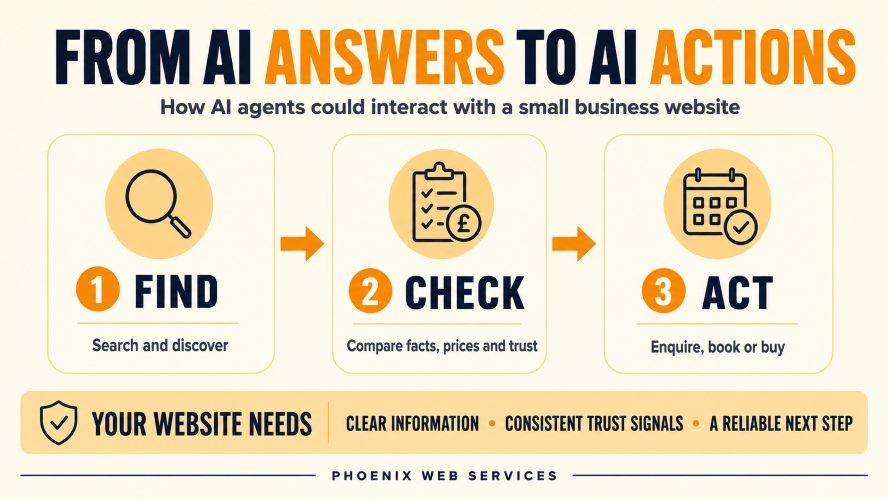
That gives us a simple progression:
- Find: Can search engines and AI systems discover the business?
- Check: Can they understand and verify the important facts?
- Act: Is there a clear, reliable and appropriate route forward?
Your current pages may already handle the first two stages well. If you are unsure, this guide to what makes a website AI-readable explains the practical foundations in more detail.
What happens when AI starts choosing businesses for us?
This is not only a technical question. It is also about influence, access and trust.
AI assistants may soon help more people narrow their options. If so, businesses may have fewer chances to make a human first impression. The details that machines can access will shape which providers reach the shortlist. Smaller firms could benefit when their expertise is presented clearly. They could also be overlooked when key facts are missing, even if their service is excellent.
Platforms will need to explain how recommendations and actions are selected. Users should be able to set preferences, review important decisions and understand when a result is sponsored. Businesses, meanwhile, will need to earn trust through evidence rather than trying to manipulate the system.
The goal should not be to persuade machines at any cost. It should be to publish accurate, accessible and useful details. That principle matters whichever route a customer takes to reach you.
Is your website ready for AI agents?
AI agents are coming, but preparation does not require panic or a complete rebuild. It requires clarity. Make your services easy to identify. Keep your business details consistent. Show why you can be trusted. Then make sure every important enquiry, booking or purchase route works as expected.
Those changes help human visitors today. They support conventional SEO. They also put your website in a stronger position as AI moves from answering questions to acting on the answers.
Frequently asked questions
What is an AI agent?
An AI agent is a system that can work towards a goal through several steps. It may use tools, gather information, take an action, check the result and adjust what it does next.
Can AI agents book appointments or buy products?
Some AI agents can already use connected tools to complete limited tasks. Their abilities depend on the system, the website, the permissions provided and the safeguards in place. Important decisions should still allow human review and consent.
Does my small business need a special AI website?
Probably not. Most businesses should first improve their existing content, structure, trust signals and customer journeys. A clear, well-maintained website is a better starting point than a fashionable plugin with vague promises.
Is agent readiness the same as GEO?
No. GEO helps generative AI systems understand and use your content in their answers. Agent readiness also considers the next action. Can a system send an enquiry or start a booking when that step is appropriate?
Most small business SEO services fall between £250 and £600 per month, depending on the level of support and competition.
In some lower-competition areas, basic SEO can help. However, very low-cost services often lack the depth needed for long-term results.
SEO usually benefits from a minimum of three to six months of consistent work, with stronger results developing over time.
In most cases, ongoing SEO is more effective, as search visibility depends on consistent updates and improvements.
- How AI agents could search, compare and act for customers
- What is the difference between a chatbot and an AI agent?
- Why a robotics announcement matters to website owners
- How to prepare without rebuilding everything
- SEO still comes first and GEO builds on it
- What happens when AI starts choosing businesses for us?
- Is your website ready for AI agents?
Want some help getting AI-ready?
Would you like an honest review of how clearly your website communicates? I can check it for search engines, AI systems and potential customers. I will identify useful improvements without selling you technology you do not need.